

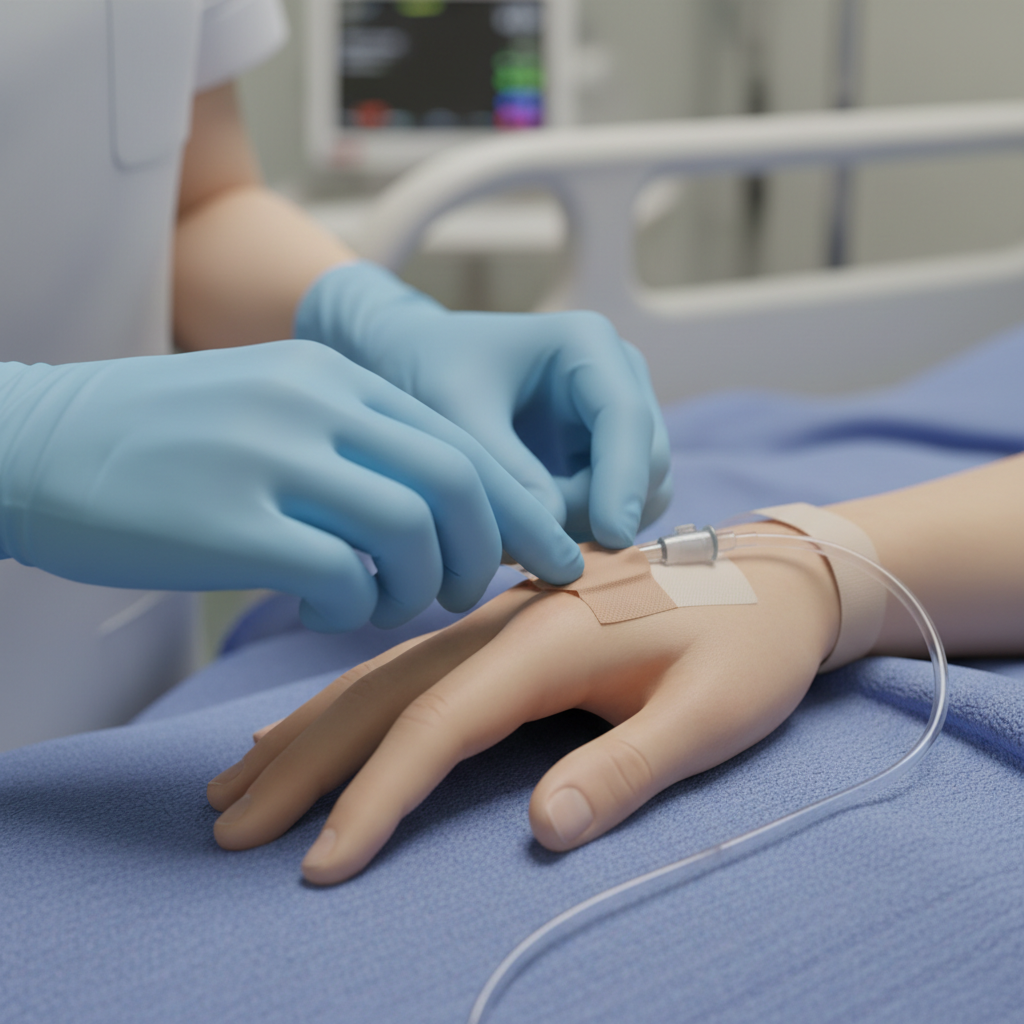
Why IV Cannulas Fail More Often Than People Admit
Ask any experienced nurse and they’ll tell you the same thing: insertion isn’t the hard part.
Keeping the line stable is.
Cannulas fail because of micro-movement. Because the patient flexes their wrist. Because post-operative swelling increases tension. Because adhesive tape was applied in a hurry. Because fragile skin simply couldn’t tolerate another removal.
And in orthopaedic wards, the challenge increases. Casts restrict angles. Splints create pressure zones. Limb positioning shifts constantly during recovery. Standard taping methods don’t always survive that environment
This is where a properly designed cannula fixator becomes more than an accessory. It becomes a control point.
Stabilisation Is a Mechanical Problem
Think about what actually causes dislodgement.
It is rarely one sudden pull. It is a repeated, subtle rotation of the hub. Tiny directional forces that accumulate over hours. Eventually, the catheter tip migrates. The site infiltrates. The IV fails.
Effective orthopedic cannula fixation must address rotational control, not just surface adhesion.
The U-shaped structure used in Omex’s design supports the cannula hub directly. That detail matters. By stabilising the base rather than simply covering the insertion site, the dressing limits torque and lateral drift.
That reduces the most common reason for reinsertion.
Not marketing theory. Mechanical logic.
Adhesion That Breathes Without Compromise
Over-adhesive dressings create their own problems. Especially in elderly patients or those on long-term infusions.
Skin maceration.
Epidermal stripping.
Moisture accumulation beneath occlusive layers.
A semi-permeable adhesive dressing balances retention with airflow. It allows moisture vapour to escape while maintaining a firm hold. That is essential when lines remain in place for extended periods.
Good fixation should not create secondary skin trauma.
And removal should not feel like removing duct tape.
The cannula fixator from Omex is engineered to stick confidently and release cleanly. That predictability is crucial in high-turnover clinical settings.
Orthopedic Wards Demand Different Thinking
In orthopaedic cases, the IV site is often near joints. Movement is unavoidable. Swelling fluctuates daily. Immobilisation devices add pressure in unpredictable ways.
Traditional taping methods often fail here because they do not absorb movement. They transmit it.
Elastic bandage integration changes that dynamic. It allows micro-flexibility. The dressing adapts rather than resists.
That subtle shift in design improves orthopedic cannula fixation in scenarios where static dressings struggle.
Small design changes. Significant clinical impact.
Sterility Is Only the Starting Point
Of course, the product is sterile. Disposable. Individually packed.
But what matters more is manufacturing control.
Omex Medical Technology operates under ISO, CE, and WHO GMP standards. Production occurs within structured clean-room facilities with in-house sterilisation validation.
Consistency between batches matters in medical disposables. Adhesive strength should not vary unpredictably. Elastic tension should remain stable. Packaging integrity must remain uncompromised.
A cannula fixator is a small device. But small variations can create big problems.
Workflow Efficiency Often Gets Ignored
Let’s talk about reality.
In busy wards, speed matters. If a dressing is awkward to apply, staff improvise. If packaging is difficult to open, time is lost. If removal causes skin trauma, dressing changes increase.
- Reliable fixation reduces reinsertion.
- Reduced reinsertion lowers patient discomfort.
- Lower discomfort improves patient satisfaction.
- Fewer interruptions improve workflow.
This is how a simple device influences hospital performance metrics.
Not dramatically. Quietly.
Where This Product Is Most Effective
- Orthopaedic recovery units
• Post-operative wards
• Trauma care
• Infusion therapy departments
• Long-stay medical facilities
In each of these environments, stable IV access directly influences treatment continuity.
When the line stays secure, therapy proceeds without disruption.
And that matters.
Why Procurement Teams Look Beyond Price
Healthcare purchasing is not about finding the lowest number on a sheet.
It is about reliability. Documentation. Delivery performance. Batch traceability.
Omex Medical Technology supports bulk orders without minimum quantity restrictions. Logistics partnerships ensure domestic and international distribution with structured packaging standards.
In institutional settings, consistency across supply cycles builds trust over time.
Trust builds long-term partnerships.
What This Cannula Fixator Actually Offers
- Semi-permeable adhesive dressing B.P.
• U-shaped cannula hub stabilisation
• Elastic fixation support
• Sterile, disposable, individually packed
• Designed for both standard and orthopedic cannula fixation scenarios
No unnecessary complexity. Just structured clinical thinking.
FAQs
How does this cannula fixator differ from standard adhesive taping?
It stabilises the cannula hub mechanically, reducing rotational movement rather than simply covering the insertion site.
Is it suitable for orthopaedic patients with swelling?
Yes. The elastic component adapts to limb movement and changing tissue volume.
Does it minimise skin trauma during removal?
It is engineered to maintain adhesion while allowing clean removal, supporting fragile skin management.
Is the product compliant with international standards?
Yes. Manufactured under ISO, CE, and WHO GMP guidelines.
Can it be supplied in bulk for hospital procurement?
Yes. Omex supports both domestic and export volume requirements.
Is individual sterile packaging included?
Yes. Each unit is sterile and individually sealed to support infection control protocols.
