

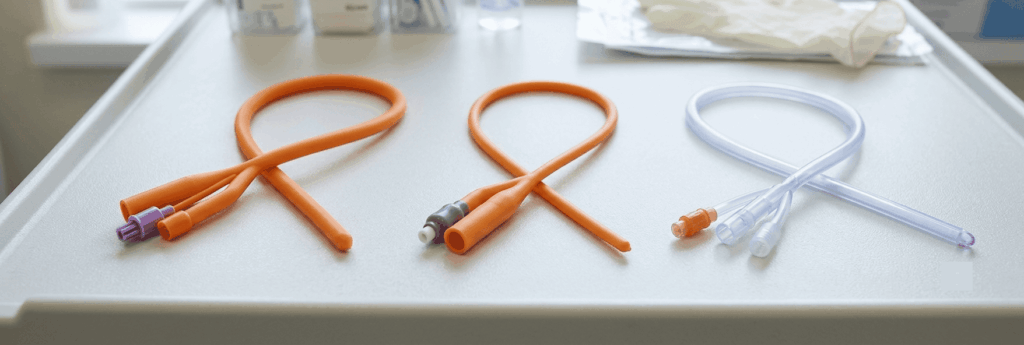
Silicone vs Latex Foley Catheters: What Should Healthcare Buyers Consider?
A Foley catheter may look like a relatively simple medical device. A flexible tube enters the bladder, a small balloon keeps it in position, and urine drains into a collection system.
The material used to manufacture that catheter, however, can affect how it performs.
Hospitals and medical distributors commonly encounter catheter options made from latex, coated latex and 100% silicone. The differences are not simply cosmetic, and the cheapest option is not automatically the most appropriate one.
Clinical indication, expected duration of catheterisation, latex sensitivity, drainage requirements and patient comfort all influence catheter selection.
For procurement teams, understanding these differences can also help build a more practical urinary-care inventory.
Why Foley Catheter Material Matters
An indwelling urinary catheter remains in direct contact with sensitive tissue, sometimes for an extended period.
Its material influences characteristics such as flexibility, internal diameter, surface friction and susceptibility to encrustation.
Current European Association of Urology Nurses guidance identifies several considerations when selecting catheter material, including:
- expected indication and duration
- latex allergy
- tissue compatibility
- tendency toward encrustation
- biofilm formation
- patient comfort
This is why hospitals frequently stock more than one catheter material rather than trying to use a single product for every patient.
What Is a Latex Foley Catheter?
Natural latex is flexible, which has historically made it useful for producing urinary catheters.
One advantage is its relatively soft and flexible structure. Latex products can also be economical, which matters for hospitals that consume large numbers of urinary catheters.
Pure latex, however, has limitations.
The material can cause problems in people with latex sensitivity or allergy. Clinical guidelines also note concerns around surface friction and encrustation when uncoated latex remains in contact with the urinary tract for extended periods.
For this reason, plain latex catheters are generally associated with shorter-term use rather than prolonged catheterisation.
Why Are Some Latex Catheters Coated?
Manufacturers can modify the surface of a latex catheter with materials such as silicone, hydrogel or PTFE.
The purpose is not merely to change its appearance.
A coating can create a smoother interface between the catheter and urethral tissue and may reduce some of the drawbacks associated with plain latex.
Silicone-elastomer-coated latex, for example, combines the underlying flexibility of latex with a silicone surface.
However, buyers should understand one important point:
A silicone-coated latex catheter still contains latex.
It should therefore not be treated as equivalent to a 100% silicone catheter for someone with a recognised latex allergy.
Product specifications and labelling need to be checked carefully.
What Is a 100% Silicone Foley Catheter?
Silicone is a synthetic material commonly used where biocompatibility and longer-term catheterisation are important considerations.
Unlike latex products, a 100% silicone catheter does not depend on a latex core.
Silicone catheters can also be manufactured with relatively thin walls. For a similar external French size, this may provide a larger internal drainage lumen than some coated alternatives.
That characteristic can be useful where drainage and encrustation are concerns.
The European Association of Urology Nurses notes that silicone may be preferable for long-term catheter use and recommends silicone for patients with latex allergy.
That does not make silicone universally superior. Its mechanical characteristics differ from latex, and clinicians still need to select the appropriate catheter for the individual situation.
Silicone vs Latex Foley Catheters at a Glance
-
Flexibility
Latex is naturally flexible and can feel softer during handling.
Silicone tends to be somewhat firmer, although the exact feel varies according to catheter construction.
-
Latex Allergy
This is one of the clearest distinctions.
A 100% silicone catheter is suitable when latex exposure must be avoided.
Latex and latex-core coated products remain unsuitable for people with latex allergy unless their precise material composition establishes otherwise.
-
Duration of Use
Plain latex is generally better suited to short-term catheterisation.
Clinical guidance more commonly favours 100% silicone or appropriately coated catheters when longer dwell periods are required.
Actual replacement schedules must still follow clinical assessment, local policy and the manufacturer’s labelled duration.
-
Drainage Lumen
Because silicone can be made with relatively thin walls, a 100% silicone catheter may provide a wider internal lumen for a given outer diameter.
This can be useful where drainage performance or recurrent blockage is a consideration.
-
Encrustation
Long-term catheter use can lead to mineral deposits building up around or within the catheter.
Guidelines note that silicone tends to have less encrustation than plain latex and may therefore be preferred in patients prone to repeated blockage.
No catheter material removes the risk completely.
What Should Hospital Buyers Check Before Ordering?
A useful Foley catheter specification should make the important details easy to verify.
Procurement teams should check the catheter material first. “Silicone”, “silicone coated” and “100% silicone” do not describe the same construction.
They should then confirm:
- French gauge sizes
- catheter length
- balloon configuration and labelled inflation volume
- sterile packaging
- intended use and labelled duration
- presence of natural rubber latex
- manufacturing and regulatory documentation
- batch and expiry identification
- packaging quantity
- supply continuity
These details become especially important when the same purchasing department supplies intensive care, surgery, general wards and long-term-care environments.
How to Build a Practical Urology Product Range
Omex Medical Technology’s B+Ve® Nephro-Uro Care portfolio includes urinary-management products such as Foley catheters, urine bags, external catheters, urethral catheters, uro meters and related renal-care devices.
For hospitals and distributors, purchasing from a broader urology range can make it easier to coordinate related products while maintaining consistent supply channels.
The correct Foley catheter still needs to be selected according to the patient’s clinical requirements and local catheterisation protocols.
The manufacturer’s instructions for use should always be followed.
Final Thoughts
The difference between silicone and latex Foley catheters is more meaningful than the material name printed on the package.
Latex provides flexibility and can be suitable for short-term applications, while coatings can improve some surface characteristics. A 100% silicone catheter avoids latex exposure and is commonly preferred where longer catheterisation, recurrent encrustation or latex sensitivity is a concern.
The right choice therefore depends on context.
For clinicians, that context is the individual patient’s requirements. For healthcare buyers, it means ensuring that the inventory offers the materials, sizes and specifications clinical teams actually need.
A well-planned catheter range does more than prevent stock shortages. It gives clinicians the ability to choose appropriately instead of adapting patient care to whatever happens to be available on the shelf.
